 Respira
Pollen and air quality, today
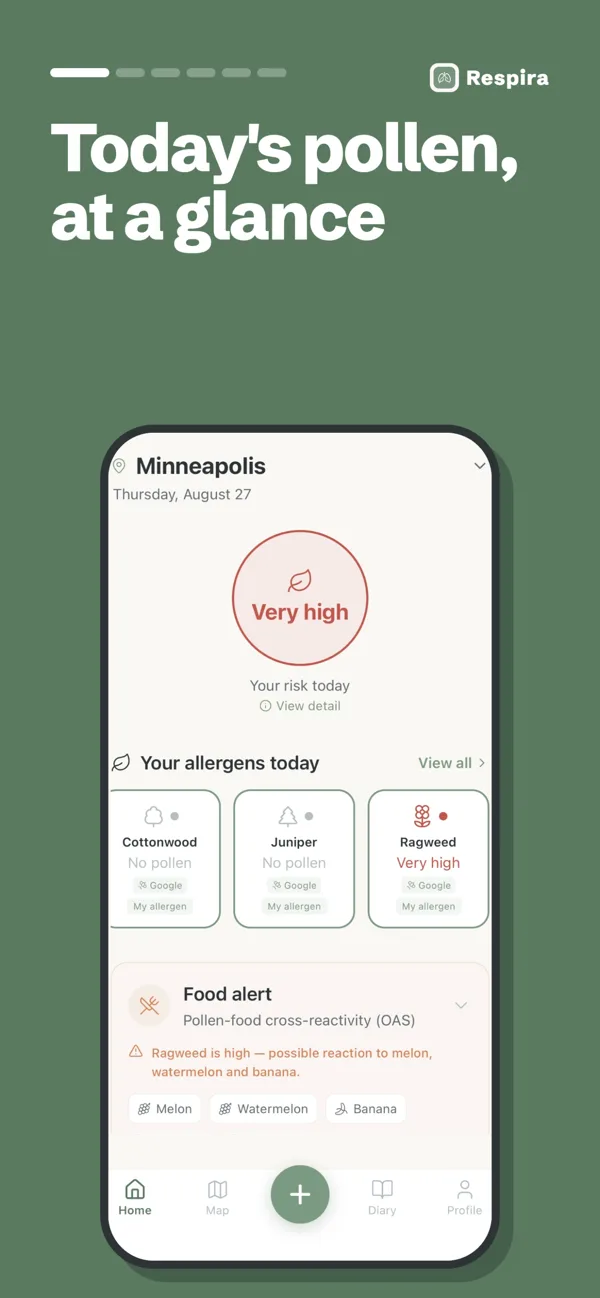
Respira shows the pollen levels and the air quality index for where you are, with a multi-day forecast and a seasonal calendar by species.
 Free for iPhone and iPad
34 countries, two data sources
In the United States, Australia, New Zealand, Argentina and Chile, Respira uses the Google Pollen API, updated daily for wherever you are: eleven species in the US, grass and cypress pine in Australia, grass in the other three. Across Europe, it uses the Copernicus CAMS model: Spain, Portugal, France, Italy, Germany, Ireland and the United Kingdom, Central Europe (Austria, Switzerland, the Netherlands, Belgium, Luxembourg, Poland, Czechia, Slovakia, Hungary, Slovenia), the Nordics and Baltics (Sweden, Norway, Denmark, Finland, Estonia, Latvia, Lithuania) and south-east Europe (Greece, Croatia, Romania, Bulgaria, Serbia). The national monitoring networks of Spain, Italy and Germany add measured readings where they publish them.
Which species you are offered depends on where you are, because the honest answer differs: ragweed, oak and mountain cedar matter in the United States, grass and cypress pine drive hay fever in Australia, birch dominates the Nordic spring, ragweed hits Hungary, Serbia and Romania in late summer, and olive and pellitory belong to the Mediterranean. Respira never shows a level for a species its source does not report there.
Pollen by city
Every US metro has a different pollen year: ragweed defines late summer in Minneapolis, mountain cedar defines December in Austin, and alder starts in February in Seattle before anywhere else has begun.
- New York, NY
- Los Angeles, CA
- Chicago, IL
- Dallas, TX
- Houston, TX
- Washington, DC
- Philadelphia, PA
- Atlanta, GA
- Miami, FL
- Phoenix, AZ
- Boston, MA
- San Francisco, CA
In the UK and Ireland, each city page has today's level by type from the Copernicus CAMS model and its own month-by-month calendar: alder from February in London, birch in April, grass from June.
Allergens in the United States
What the app does
Today's levels, by species. Only the allergens you have selected, only where they are actually reported.
Air quality on the right scale. The EPA index in the United States, the European index elsewhere — 49 is "Moderate" on one and "Good" on the other, so showing the wrong one would be worse than showing none.
A symptom diary. Record how you felt; the app pairs it with the pollen that day. Export a report for your allergist as a PDF.
Smart notifications and a trip planner are part of Respira Pro. Set a threshold per allergen and get told the morning it is crossed, in any of your saved places.
When we have no data, we say so
Pollen models have gaps — a species with no coverage, a source that did not answer, a cell outside the model's domain. Respira shows "no reading" for those rather than a zero. "No pollen" is a measurement; "we have no data" is not, and the two should never look the same on a screen you are using to decide whether to go outside.
Download Respira free
Pollen levels for where you are, a multi-day forecast, air quality and a symptom diary. Free, for iPhone and iPad.
Respira is an informational tool. It does not replace diagnosis or advice from a medical professional.